The short answer
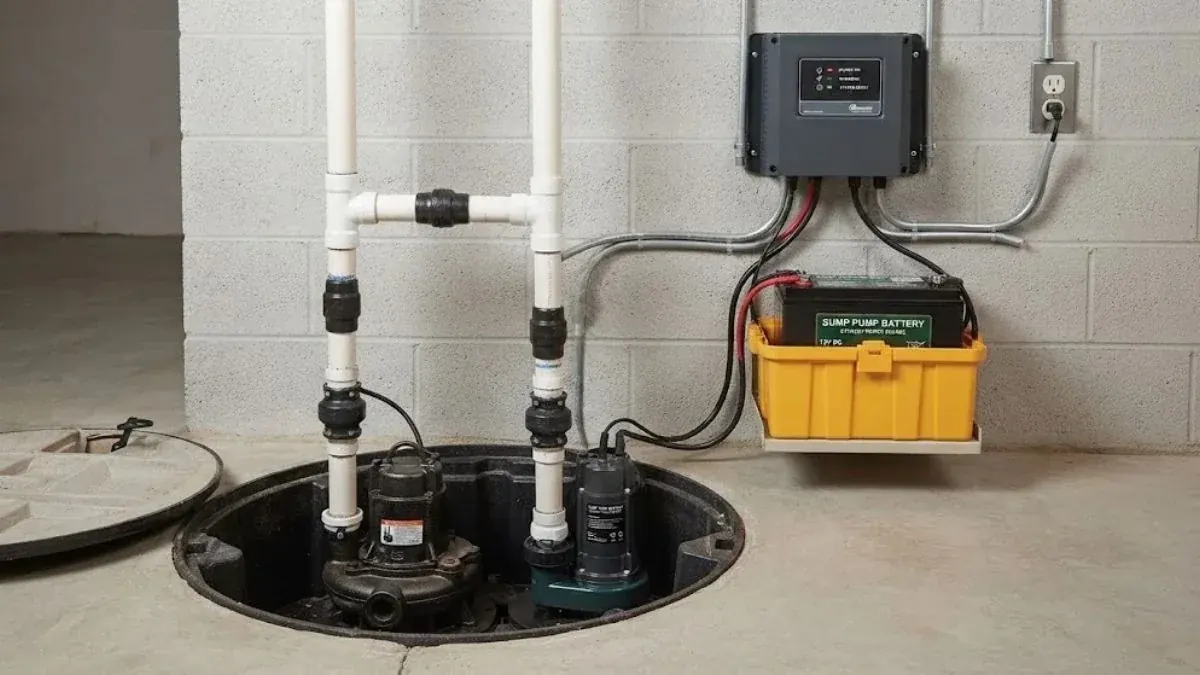
A battery backup sump pump is a second pump with its own battery, charger and float switch. It sits in the same pit, a little higher than the main pump, and starts if the main pump fails or the power goes out. Without one, a power outage in a storm leaves the pit with no pump.
Backup types
| Type | How it works | Limits |
|---|---|---|
| Battery backup | A 12 volt battery runs a DC pump through a controller | Runtime depends on battery size and how often the pump runs |
| Water-powered backup | Uses house water pressure to pump out water | Needs municipal water pressure, so it is not for private wells |
| Generator | Powers the main pump during an outage | Needs a transfer setup and fuel |
| Second AC pump | A spare pump on the same power | Helps if one pump fails, not if power fails |
For most homes on town water, a battery backup is the practical choice. A generator also works if you already own one.
How to size a backup
How often the main pump runs in a heavy storm.
How fast the pit fills, which sets the pump capacity you need.
How long outages last in your area, which sets the battery size.
How high the discharge needs to lift the water.
Whether the pit is large enough for two pumps and floats.
A small battery that runs for a short time is better than nothing, and a larger one is better in a long storm. We size it to your pit.
What an installation includes
We check the pit, the main pump and the discharge line.
We set the backup pump on a stand or bracket slightly above the main pump.
We add a check valve, a separate float and a connection to the discharge.
We mount the battery and controller above the floor, with an alarm.
We test both pumps by lifting the floats and simulating a power loss.
Ask about the alarm. A beep that tells you the main pump failed or the battery is low is worth the extra cost.
Maintenance that keeps it working
Test the pumps every few months by pouring water into the pit until the float lifts. Check the battery terminals for corrosion, and keep the charger plugged in. Most makers suggest replacing the battery every few years, and a dead battery is the most common reason a backup fails.
Clear the pit of silt and debris once or twice a year. A float that sticks on debris will not start. If the pump keeps cycling, see basement waterproofing for why.
Mistakes that leave a backup useless
Letting the battery age past its life without testing it.
Plugging the charger into an outlet that is on the same tripped circuit.
Mounting the backup float lower than the main float, so it fires first or never.
Using the same discharge pipe without a separate check valve.
Never lifting the floats to confirm that both pumps start.
A backup that has never been tested is a hope, not a system. A five minute test every few months proves it.
Setting up two pumps in one pit
| Part | Main pump | Backup pump |
|---|---|---|
| Float height | Lower, starts first | Slightly higher, starts if water keeps rising |
| Power | House current | 12 volt battery and charger |
| Discharge | Own pipe and check valve | Own pipe or a tee with a second check valve |
| Alarm | None or a high-water alarm | Audible alarm for failure or low battery |
Separate check valves keep the two pumps from pushing water back through each other. Ask how your installer plans to do it.
Water that keeps coming in despite the pumps
A sump system moves water that reaches the pit. If a pump runs constantly in a storm, the pit may be overwhelmed, the pump may be undersized or the water table may be very high. More pumping power helps, but so does fixing where the water enters.
That is where basement waterproofing and drainage come in. A system that collects water at the footing and sends it to a well-sized pit performs better than a pump alone. We size the pit, the pump and the backup as one system.
Caring for the battery
A backup battery is a deep-cycle battery that sits on a charger for years and then must perform in a storm. Its life is limited, and a battery that tests fine in spring may be weak by the next winter.
Check the charger light each season and test the system by lifting the float or pouring in water until the backup runs. Replace the battery on the maker's schedule, not when it fails.
Add a high-water alarm if your system lacks one. A loud alert in the middle of a storm gives you time to act, whether that means moving belongings, running a second pump or calling a plumber.
If the power goes out for a long stretch, a battery lasts only for hours of pumping, not days. A generator or a larger battery bank is the next step for a house that floods during outages. We can talk through what size matches your pit and how often the main pump runs in a storm.
Check the permit and the discharge rules
Bridgewater's Building Department says plumbing work tied to a building project needs a separate permit, and it runs an electronic permit system. Whether a sump pump or a backup install needs a permit depends on the job, so ask the department.
Where the discharge goes also matters. A line that dumps at the foundation sends water back to the pit. Ask your plumber to run it away from the house, and avoid discharging onto a neighbor's lot or into the sanitary sewer.
Source type: municipal building department pageWhere we install
We install backups in Bridgewater and in Raynham and Halifax. Tell us what is in your pit now and we will plan the setup.
Sources and standards for this guide
The maker's installation manual is the standard for float settings and battery sizing. Discharge routing follows 248 CMR 10.00 and local drainage rules.
Questions readers ask
It depends on the battery and how often the pump runs. A larger battery lasts longer in a heavy storm.
A new pump still fails when the power does. A backup covers that.
Many makers suggest every few years. Check the manual and test it.
Generally no. Sump water belongs in a storm path. Ask the town and your plumber.
Yes. Our line is open 24/7. See emergency sump pump repair.
Still have a question? Call (508) 389-4045 and we will answer it.