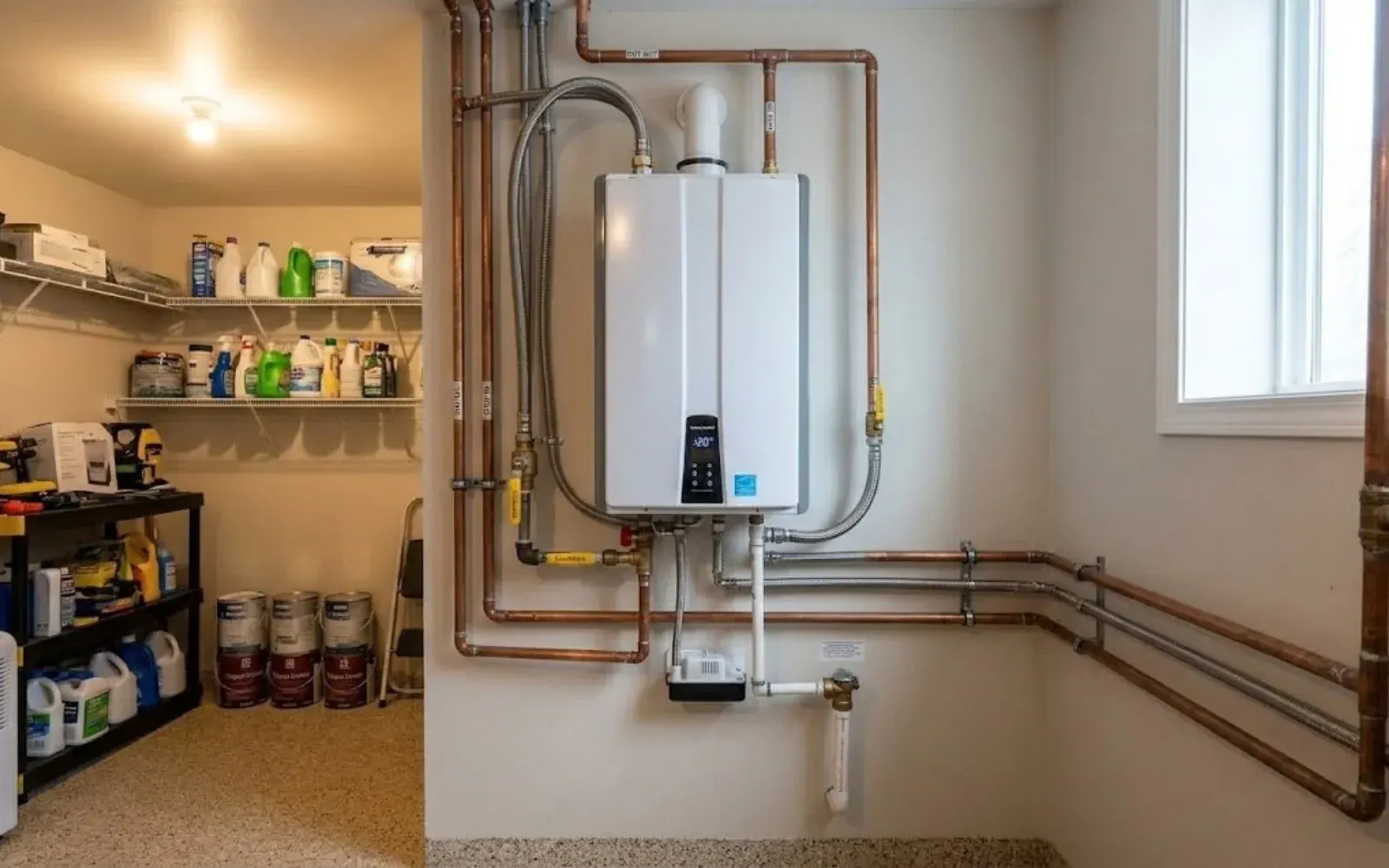
When a failed water heater cannot wait
A tank that is leaking, rusted through at the base or cold for good calls for emergency water heater replacement in Bridgewater, MA, and our line is open 24/7 to book it. While you wait, close the cold water valve on top of the tank, set the gas control to off (or flip the breaker for an electric unit), and open one hot tap upstairs so the tank is not holding pressure.
Put towels or a shallow pan at the base and move anything stored nearby. If water is spreading toward a finished basement or the electrical panel, shut off the main water valve instead. Then call us and say the fuel type, the tank size on the label and where the unit sits.
Replacement means draining and removing the old tank, setting a new one, reconnecting water, gas or electric and the vent, then testing the work before we leave. Many swaps finish in one visit when the right unit is on the truck.
Signs the tank is finished, not just tired
Water collecting at the base that is not coming from a pipe fitting or the relief valve line.
Rust-colored hot water while the cold side runs clear.
Loud rumbling or popping as the burner or element runs.
A unit past roughly 8 to 12 years, which is a common working life for a tank water heater.
Two or three repairs in a short stretch, each one fixing a different part.
One of these alone can be a repair job. Several together usually mean the tank steel is the problem, and a new part will not fix that. If you only have no hot water and no leak, start with water heater repair because a failed element or thermocouple costs far less than a new tank.
What Bridgewater groundwater means for your tank
Bridgewater's public water comes from groundwater wells. The state's source water assessment for the Bridgewater Water Department lists nine gravel-packed wells, with iron removed by filtration at some and held in solution with phosphates at others. Iron and mineral grit that reach a home settle as sediment on the bottom of a tank.
That matters when you choose a replacement. A tank that rumbles late in life is usually sitting on a layer of sediment, and once the steel beneath it has cracked, flushing cannot save it. On a new unit, a yearly flush and an anode rod check slow the same build-up.
We do not quote a hardness number here because it changes and the town publishes its own annual water quality report. Ask the Water Department for the current report, or test your tap, before deciding on a softener or a unit with a longer warranty.
How a replacement visit runs
We confirm the fuel, the tank size and the venting, then give you a price before any work begins.
We shut off and drain the old tank and disconnect it from water, gas or power.
We set the new unit, fit new supply connections and a pan where space allows, and add an expansion tank when the system needs one.
We reconnect and check the vent, light or power the unit and test for leaks and temperature.
We take the old tank away and show you the shutoff valves so you know where they are.
Choosing the replacement type
| Option | Fits when | Trade-off |
|---|---|---|
| Standard tank, same size | The existing space, venting and fuel line already work | Lowest upfront cost and the fastest swap |
| Larger or taller tank | The household has outgrown the old tank | May need a new stand, vent or clearance |
| Tankless unit | You want continuous hot water and have the gas or power capacity | Higher install cost and a flush schedule |
| Heat pump unit | An electric tank is being replaced and the space is open and unheated | Needs air clearance and a condensate drain |
Switching fuel or moving the unit turns a swap into a planned job. That is closer to water heater installation, and we will say so when we price it.
What changes the price of a swap
| Factor | Why it matters |
|---|---|
| Tank size and type | A 40 gallon standard tank costs far less than a 75 gallon or a tankless unit |
| Fuel and venting | Gas units need a safe vent path, and a failed or undersized vent adds work |
| Access | Attic, crawlspace and tight closet installs take longer |
| Code items | Expansion tank, relief valve line, pan and any permit step |
| After hours | Night and weekend call-outs carry a premium, and we tell you before booking |
Homeowners insurance usually responds to sudden and accidental water damage, such as a tank that burst, and usually does not pay for the worn-out tank itself. Read your policy or ask your agent. Want your real number? Call (508) 389-4045.
Permits and licences in Massachusetts
Massachusetts requires plumbing work to be done by a licensed master or journeyman plumber under the state's Uniform Plumbing Code, 248 CMR 10. A local plumbing inspector issues the permit before the work starts, and permit steps vary by job, so ask the Bridgewater Building Department how it handles water heater swaps.
You can check any plumber's licence with the state Board of State Examiners of Plumbers and Gas Fitters through the mass.gov license verification page. Ask to see the permit as well, because it is your record that the work gets inspected.
Code and sources for this work
Installs follow the Massachusetts Uniform State Plumbing Code, 248 CMR 10.00, which is the state standard for water heater piping, relief valves and discharge. Gas-fired units also fall under the state fuel gas code.
Water heater replacement questions
Yes. The line is open 24/7. For a leaking tank we ask for the fuel type and tank size, give you shutoff steps over the phone, and book the earliest slot. After-hours work carries a premium and we tell you the price before we book.
A single failed part on a tank under about 10 years old is usually worth repairing. A leak from the tank body, heavy rust or repeated repairs point to replacement. We tell you which one it is before you spend anything.
Many standard swaps take a few hours once the unit is on site. Fuel changes, new venting and tight access take longer, and we give you a window when we price the job.
Yes. We drain it, disconnect it and take it with us as part of the job.
It depends on gas capacity, venting and how much hot water you use at one time. Our tankless water heater page covers the trade-offs and the flush schedule they need.
Still have a question? Call (508) 389-4045 and we will answer it.