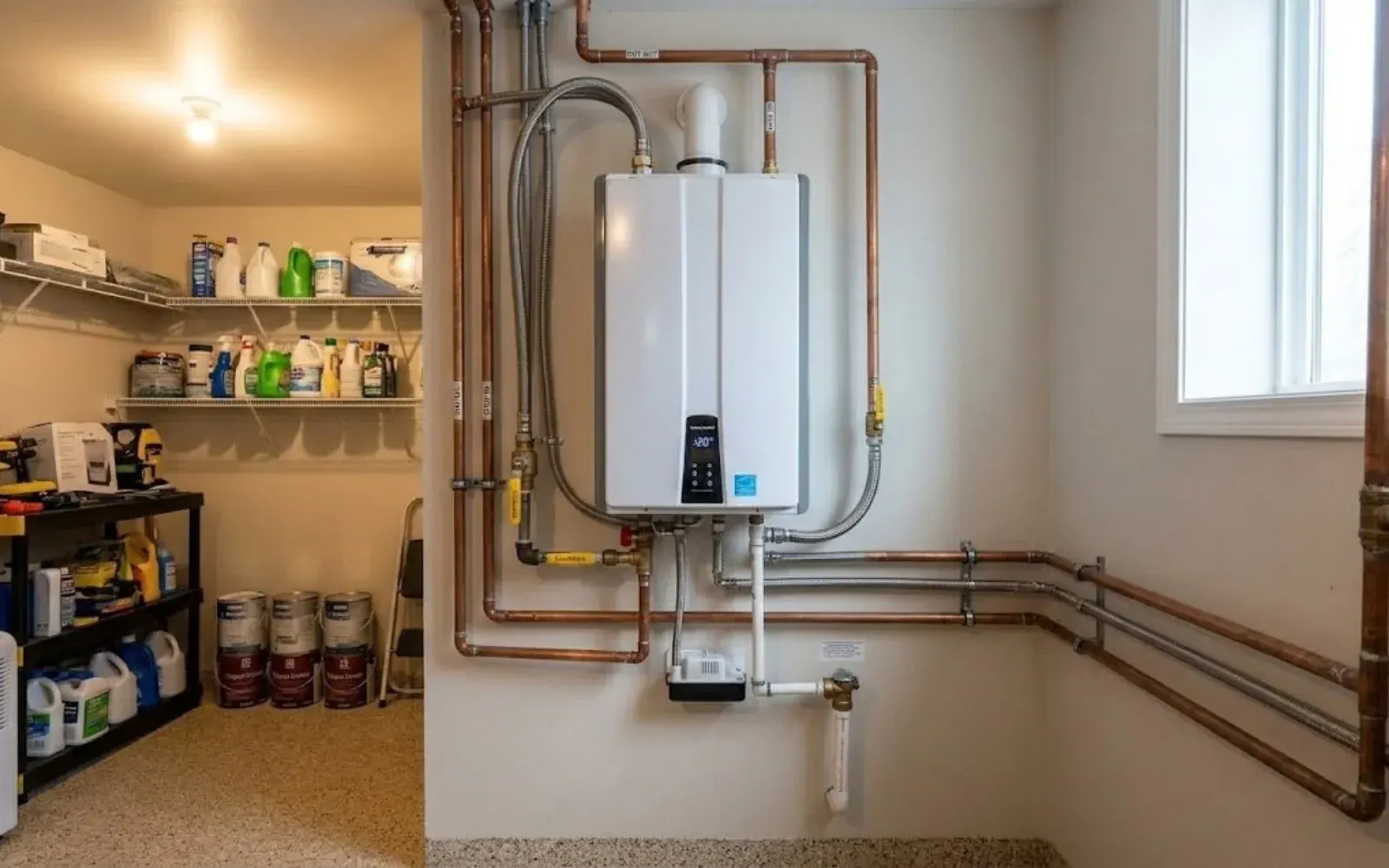
The short answer
Use the vent material and brand that the tankless unit's instructions list. Non-condensing units run hot and usually need stainless steel. Condensing units run cooler and often allow certain plastic vent pipe, but only the types the maker lists. Mixing brands or using an unlisted material voids the listing and can be unsafe.
Common vent materials
| Material | Where it is used | Watch for |
|---|---|---|
| Stainless steel, double wall | Non-condensing units and some outdoor runs | Must be the right alloy and sealed at every joint |
| PVC or CPVC | Condensing units, when the maker lists it | Temperature limits and listed brands only |
| Polypropylene | Some condensing units | Use the maker's matched system and joints |
| Single wall galvanized | Rarely allowed for tankless | Often not acceptable for modern units |
Check the manual before buying pipe. A cheaper pipe that is not listed costs more when it is torn out.
What limits a vent run
Total equivalent length, where each elbow counts as extra feet.
Slope back to the unit for condensate or toward the outside as the maker directs.
Distance to windows, doors and air intakes at the termination.
Supports and spacing so the pipe does not sag.
Combustion air in the room, if the unit is not direct vent.
A long run through a finished wall or ceiling is the usual reason a tankless install costs more than expected.
Condensate and corrosion
A condensing unit makes acidic condensate, and that water has to go somewhere. It usually runs to a drain through a neutralizer. A condensate line that clogs or freezes can trip a safety shutdown. In a cold utility room, insulating or relocating the line is part of the plan.
Stainless is corrosion-resistant but not immune. A damaged or pitted vent should be replaced, and a plumber checks the joints on every service. Our tankless water heater service includes the vent check.
How we plan a tankless vent
We read the model's installation manual and the allowed materials.
We measure the route from the unit to the outside, counting elbows.
We confirm the termination location against windows, doors and the property line.
We plan the condensate drain, or the neutralizer, if the unit is condensing.
We give you the vent plan and the price before we order parts.
Mistakes with tankless venting
Using a vent brand that is not listed for the unit.
Exceeding the maximum length or the number of elbows.
Skipping the slope or the supports the maker requires.
Venting too close to a window, door or air intake.
Failing to seal the joints or to use the maker's gaskets and clamps.
Each of these can create a safety hazard or void the warranty. A plumber who works from the maker's installation manual avoids them.
Exterior terminations and winter
A vent termination on an outside wall is exposed to wind, rain and snow. A termination near the ground can be blocked by snow, and one under an eave can collect ice. A blocked termination makes the unit shut down on an error code, usually at the worst time on a cold day.
Locate the termination above the expected snow line and away from walkways where ice would form. Check it after a storm. A simple glance outside can explain a unit that will not fire on a winter morning.
Direct vent and indoor air
| Setup | Where combustion air comes from | Result |
|---|---|---|
| Direct vent | Sealed pipe from outside | Indoor air is not used, so the room matters less |
| Power vent, indoor air | From the room | Needs adequate combustion air |
| Atmospheric | From the room | Depends on the flue and house air balance |
A direct vent unit is often the practical choice in a tight house because it does not compete with other appliances for air.
Why the vent material matters
A high-efficiency tankless unit produces hot, acidic exhaust. The vent has to be made of a material the maker lists for that exhaust, and a pipe that is not rated can corrode, leak or fail early.
Stainless steel is a common choice for the vent on many models because it handles heat and moisture well. Some units use approved plastic instead, so the manual decides, not the plumber's preference.
Follow the manual for the pipe type, the joint method and the support spacing. A listed vent installed as the maker describes protects the warranty, and it protects the people living in the house from exhaust gas.
A vent that looks fine from the outside can still be wrong inside. Check the clearances to windows, doors and the gas meter, the slope back toward the unit for condensate and the support at each joint. Those details are easy to miss and hard to see once the pipe is covered, which is why a final inspection matters. Our tankless water heater page explains how we plan an install from the vent outward, and we are glad to answer questions about your specific model before you buy.
Where the code and permit sit
West Bridgewater's building department page lists the Massachusetts gas code, 248 CMR 4.00, the amendments to NFPA 54 in 248 CMR 5.00 and the Uniform Plumbing Code in 248 CMR 10 among the codes its inspectors enforce. Bridgewater's Building Department says plumbing and gas work tied to a project needs its own permit.
Venting a gas appliance is regulated work, so ask the Bridgewater Building Department what it requires and have a licensed plumber pull the permit.
Source type: state regulation listing from a municipal building pageWhere we install
We plan tankless vents in Bridgewater and in East Bridgewater and Halifax. For a comparison with a conventional tank, see water heater installation.
Sources and standards for this guide
The vent material and length limits come from the unit's listing and installation manual, which are the standard for the job. Gas piping follows 248 CMR 5.00.
Questions readers ask
Only if the maker lists it for your unit. A non-condensing unit usually needs stainless.
The manufacturer's table sets it, counting elbows as extra length.
Often yes for a condensing unit. The maker and the local rules decide.
Rarely. A new unit usually needs a vent that suits it.
A licensed plumber pulls it. Ask the Building Department what it requires.
Still have a question? Call (508) 389-4045 and we will answer it.