The short answer
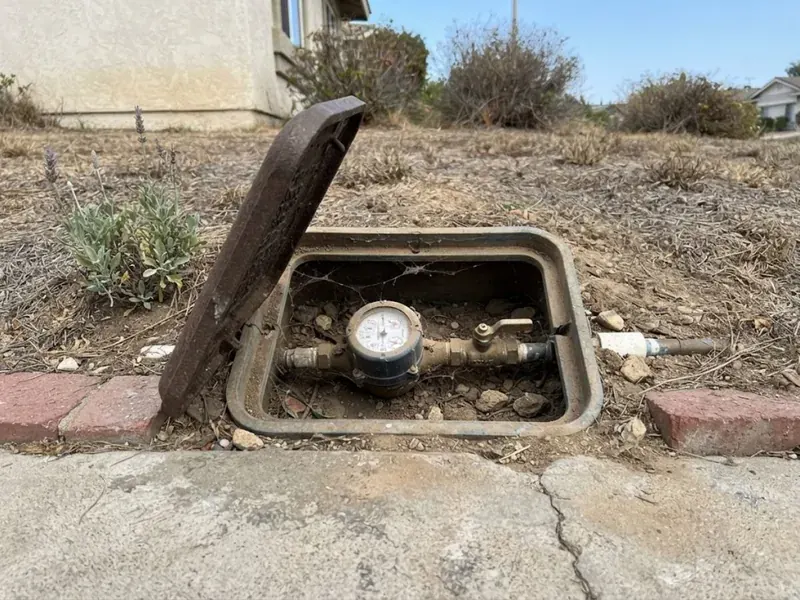
If your water meter keeps moving with every tap and appliance off, water is leaving the system somewhere. If it stops when you close the main valve inside the house, the leak is inside the house. If it keeps moving, the leak is in the buried line between the meter and the house. That one test saves a lot of guessing.
Signs of a leak you cannot see
A patch of lawn that stays soft or green when the rest is dry.
Water pooling near the foundation or the curb with no rain.
A sudden drop in pressure at every tap.
A water bill that jumped without a change in how you use water.
The faint sound of running water at night when everything is off.
One sign can have another cause. Two or three together make a buried leak much more likely.
How to run the meter test
Turn off every tap, the ice maker, the irrigation system and any appliance that uses water.
Open the meter box and look at the leak indicator, a small triangle or dial that spins with any flow.
Write down the meter reading, wait 30 minutes with nothing running, and read it again.
If the number moved, close the main valve inside the house and check the indicator again.
Call a plumber with what you found.
How a plumber finds the exact spot
Digging blind is how a small leak turns into a trench through your yard. A plumber starts with a pressure test on the line to confirm the leak, then narrows the location with acoustic listening gear. Escaping water makes a sound that travels along the pipe, and a ground microphone picks it up at the surface.
On plastic pipe, where sound does not travel well, a tracer gas or a thermal camera may help. The goal is a small, precise excavation, not a trench. Our leak detection service uses this sequence.
Repair or replace the buried line
Once the leak is found, the choice is a spot repair or a new line. A single leak on an otherwise sound line is often a spot repair. A line that has leaked more than once, or is made of an old material, is usually better replaced. Water line repair explains the options, including trenchless methods that cut down on digging.
Think about the cost of the water too. A leak the size of a pencil lead can lose hundreds of gallons a day, and that adds up on a bill quickly. A fast repair often pays for itself.
What causes a buried line to leak
Corrosion in old steel or galvanized pipe, which thins the wall until it pinholes.
Ground movement and frost, which stress joints and fittings over winter.
Tree roots that press on a line and crack plastic or loosen a joint.
Poor workmanship at a connection, such as a fitting that was never fully seated.
Damage from digging, a fence post or a utility crew that nicked the pipe.
The cause shapes the fix. A single failed fitting is a small repair. A line that is corroding along its whole length is a replacement, because patching one hole leaves the next one waiting.
What a leak costs in water alone
A steady flow of one gallon a minute sounds small. Over a day it comes to 1,440 gallons, and over a month it is about 43,000 gallons. Most buried leaks are slower than that, but even a fraction of it shows up on a bill, and on a metered line you pay for every gallon that escapes.
That is why a bill that doubles with no change in how you live is worth chasing the same week. Waiting also gives the water time to undermine soil, wash out a driveway edge or soak a foundation, which turns a pipe repair into a pipe and a landscaping repair.
Mistakes that make a buried leak worse
Digging a trench by guesswork before the leak is located.
Assuming a wet patch in the yard sits directly above the leak, since water travels along the pipe trench.
Waiting for the next bill to confirm the first one.
Hiring someone who cannot show a licence or a permit for the work.
A pinpoint search first and a small, planned dig second is almost always cheaper than the alternative.
How a pinpoint search works
We start at the meter. With every fixture off, a moving dial or a spinning low-flow indicator tells us water is leaving the house somewhere. Then we close the main shutoff and watch again, which separates a leak inside the house from one on the buried line.
If the leak is outside, acoustic listening gear picks up the hiss of escaping water through the soil, and a correlator compares the sound at two points to estimate distance. Where the ground allows, tracer gas or a thermal camera confirms the spot before anyone picks up a shovel.
The result is a small, marked area instead of a long trench. That protects the lawn, the driveway and your budget, and it gives you a clear scope before any repair is quoted.
What to ask the town in Bridgewater
The town's website links a Final Water Meter Reading request form, and the Water Division's system dashboard describes mandatory outdoor water use limits during a declared supply emergency that took effect in December 2025. If your meter is spinning, tell the department and ask where its responsibility for the line ends and yours begins.
Do not run a hose or an irrigation system to test for a leak while restrictions apply. Use the meter test above, which uses no outdoor water.
Source type: municipal website and water system dashboardWhere we serve
We take buried line calls in West Bridgewater and Raynham as well as every part of town from the Town Common to South Bridgewater. Tell us the address, the meter reading and what you see.
Sources and standards for this guide
According to the EPA, the average home loses nearly 10,000 gallons of water a year to leaks, and a meter check is the standard first test. Repairs follow 248 CMR 10.00.
Questions readers ask
It depends on the size of the leak and the line pressure. Even a small leak can waste hundreds of gallons a day, which is why the bill jumps.
Many policies cover sudden damage but not wear or slow leaks, and some exclude the line itself. Read your policy and ask your agent.
No. Dowsing is not a reliable method. A meter test and acoustic gear find the spot.
Ask where the town's responsibility ends and yours begins and whether its dashboard shows any work or restrictions on your street.
No. It can be groundwater, a sprinkler line or a drain. We check before digging.
Still have a question? Call (508) 389-4045 and we will answer it.