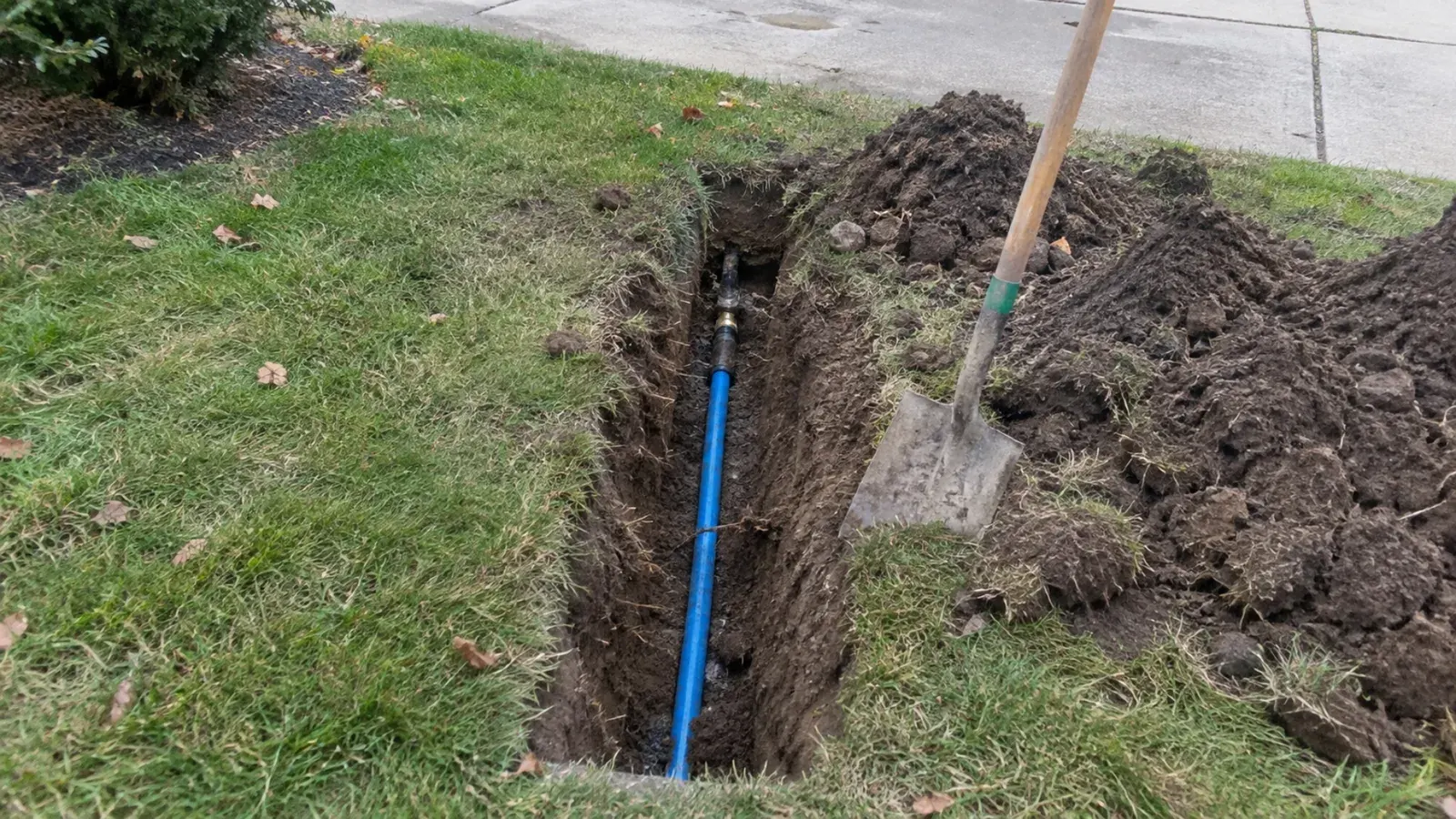
A failed water line is an emergency
No water, a soaked yard or a meter spinning with every tap closed can mean an emergency water line repair in Bridgewater, MA, and we answer 24/7. Close the main valve inside the house. If water still shows at the meter, the leak is between the meter and the valve, and the town may need to shut the curb stop.
Call us and say what you see. We ask where the line enters the house, how old the house is, what the pipe appears to be made of and whether the water pressure dropped before the leak. Ask us about timing.
Signs of a buried line leak
A wet, soft or unusually green patch of yard between the street and the house.
A meter that moves when every tap is closed.
Low water pressure throughout the house that did not exist before.
A sudden jump in the water bill.
The sound of running water when everything is off.
These are also leak detection signs, and leak detection pinpoints the spot before any digging starts.
Where the line runs and who owns what
A service line runs from the water main under the street to the meter or the main valve in the house. The utility owns the main and usually the connection. The homeowner is commonly responsible for the line from a certain point, such as the curb stop or the meter, to the house, but the exact split varies.
Call the Bridgewater Water Department to ask where your responsibility begins. The town's water page also lists a Lead Service Line Replacement Program with a grant, so ask whether your line is part of it before you replace it. We help you sort out what is yours and what is not.
Repair or replace the line
| Option | Fits when | Trade-off |
|---|---|---|
| Spot repair | One leak on an otherwise sound line | Cheaper, but other weak spots may follow |
| Trench replacement | The line is old, corroded or leaking in more than one place | Digging and restoration, but a new line lasts |
| Trenchless replacement | The route is hard to dig, such as under a driveway | Needs the right soil and entry points |
| Lead or galvanized line | The line is a known lead or steel material | Replacement is usually the better answer |
A line that has been repaired several times usually needs replacement. If pipes inside the house are also failing, repiping may pair with a new service.
Low water pressure and the meter
Low pressure can come from the service line, a partly closed valve, a failing pressure reducing valve, scale in older steel pipes or a municipal issue. We test the pressure at an outside hose bib and at the main to find where it drops.
If the pressure is low at the meter too, ask the Water Department whether work or a restriction is affecting your street. The town has posted outdoor water use limits during a declared supply emergency, and its dashboard says water is blended through the distribution system, so check town notices before you assume the problem is on your side.
What changes the price of a water line job
| Factor | Why it matters |
|---|---|
| Length and depth | A long, deep run costs more to dig |
| Surface | Lawn, driveway and walks affect restoration |
| Method | Trench, trenchless or spot repair differ widely |
| Pipe material | Copper, PEX and plastic service lines have different costs |
| Permit and utility | Town permits and coordination with the Water Department |
Insurance rarely covers a failed service line, though some policies sell a service line endorsement. Ask your agent. Want your real number? Call (508) 389-4045.
Code and sources for this work
Service lines are regulated by the local water department and by the state drinking water rules, 310 CMR 22.00. The EPA Lead and Copper Rule is the federal standard that now drives lead service line inventories and replacement.
Water line questions
Yes. The line is open 24/7. We tell you how to shut off the water and book the earliest slot. After-hours work carries a premium, quoted before you commit.
Close the main valve and check the meter. If the meter keeps moving, the leak is between the meter and the valve.
The split varies. Ask the Water Department where the town's part ends and yours begins.
Sometimes. Trenchless methods need entry points and suitable soil. We tell you which fits.
Ask the Water Department whether your service line is eligible. We can tell you what material we see.
Still have a question? Call (508) 389-4045 and we will answer it.